03.02.2026 | Authors: Luis Fernando Arias and Carlos Martínez.
Para leer en español, cliquea aqui
This blog summarises the podcast ‘Educational Community Technology: Transforming Digital Autonomy’ (in Spanish) co-hosted by Carlos “cacu” Martínez and Luis Fernando “Luis Fer” Arias, from the Jaaklac Community 2025. Jaaklac researches and promotes Critical Digital Education (CDE) through its Principles of Collaboration and Coexistence. On this occasion, Cacu and Luis Fer reflected on CDE and the issues that motivate them, such as community technology for teaching and learning inside and outside the classroom.
a. What does it mean for you to talk about ‘technological autonomy’ and in contexts of digital inequality?
cacu: That’s a difficult question. Above all, I like that you’ve added the context of digital inequality. I’ve been fortunate to be able to experience educational processes in very different contexts: public squares, hacklabs, hackerspaces, juvenile detention centres, social centres, public and private universities, among other spaces.
Based on this background, I believe that technological autonomy involves having reasonably functional devices that allow access to the internet, which can facilitate access to information, carry out procedures, socialise, entertain oneself and support educational processes.
Technological autonomy also involves the development and use of proprietary technologies; however, this possibility is deeply conditioned by socio-economic factors. From my experience in the so-called majority world, it is uncommon for people to have their basic needs met, which makes it difficult to exercise different forms of autonomy, including technological autonomy.
At the same time, in community spaces and/or with limited resources, it is sometimes possible to hack devices, software, protocols and ways of doing things, in order to adapt them and make them more useful for us and our communities.
Luis Fer: I believe that for me, technological autonomy is learning to create our own technology for our individual and collective goals. It is a way to counteract digital inequality because through technological autonomy we can think of new forms of connectivity and access to knowledge. It is learning by doing and sometimes by breaking things.
b. What gaps or dependencies do you seek to transform with your educational work in digital autonomy?
cacu: How we approach, enjoy and use devices depends not only on the device itself, but also on the type of device. Unfortunately, many of them are very difficult to modify; however, some can be altered and transformed into much more useful tools, giving them a new lease of life. These include routers, computers and telephones (to a lesser extent).
During my nine years in hackerspaces, I have had the opportunity to learn, teach and facilitate processes for modifying these devices, with the aim of reducing technological dependence. I seek to learn and share that although most technological devices are created in the global north, we can give them another use, a use that is more in line with our needs and those of our communities.
Luis Fer: Through the learning spaces I have promoted, I like to break the dependence on large platforms. Large technology companies use technological facilitation to trap users, but today many free software tools are very intuitive and user-friendly.
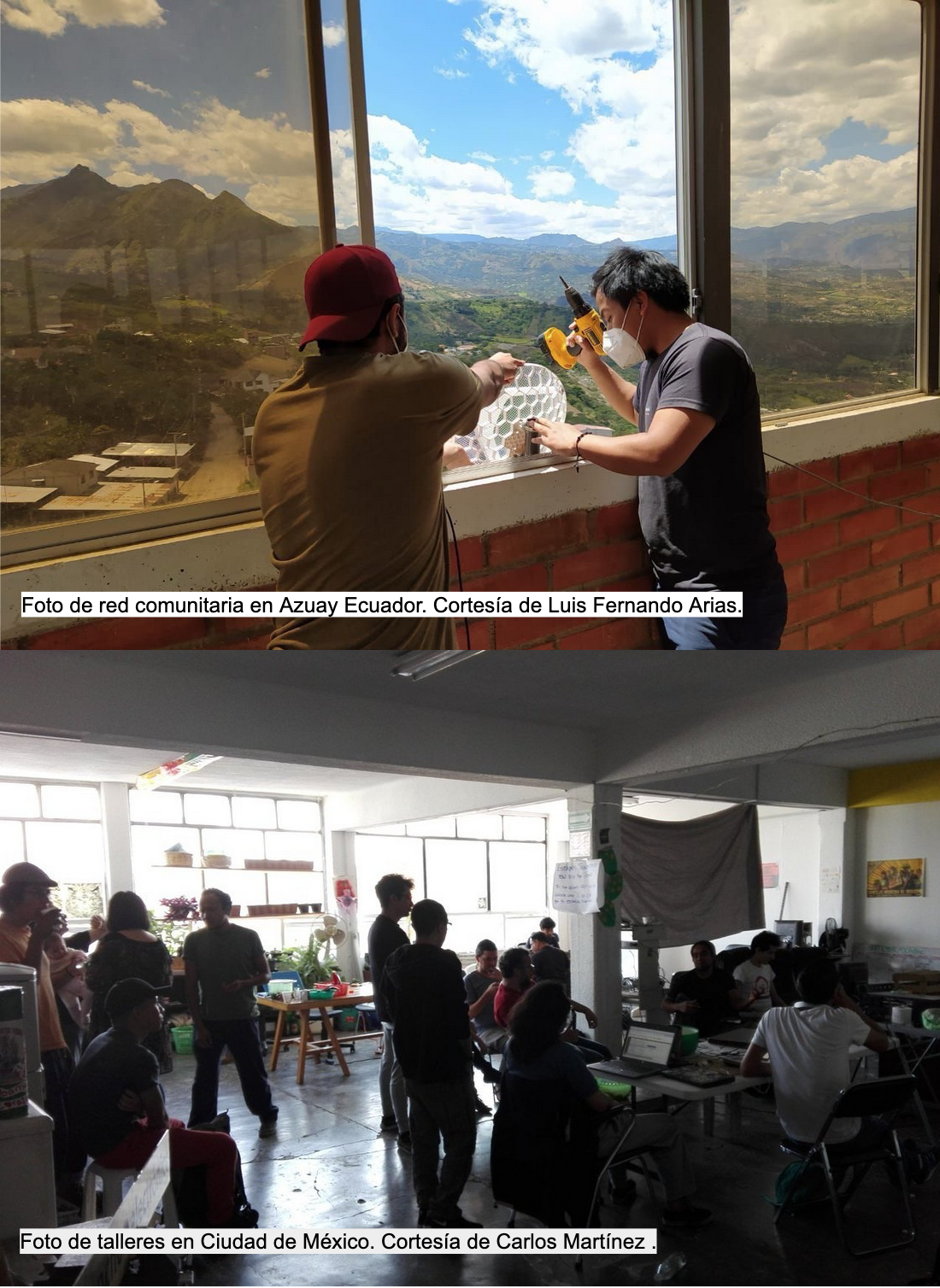 Above: Photo of community network in Azuay, Ecuador. Courtesy of Luis Fernando Arias. Below: Photo of workshops in Mexico City. Courtesy of Carlos Martínez.
c. How can we teach and learn critically with digital technology?
Luis Fer: Learning and teaching are two closely related processes, because when we teach, we also learn. To generate meaningful learning, people must have intrinsic motivation, something that motivates them internally to learn; external motivations alone are not enough.
Creating things is exciting and can motivate us to continue learning. If I see that something works, I can understand the world around me in a more interesting way.
Cacu: We learn and teach from a place of humility, from seeing ourselves as peers, as peers who are unfamiliar with and knowledgeable about many topics, from different professions, and with different abilities.
In dismantling technosolutionism, it is important not to think of digital technology as the solution to humanity’s problems, especially considering that digital technology is built on land dispossession and the exploitation of bodies.
d. How does this digital education differ or complement each other inside and outside the classroom?
Luis Fer: Teaching and learning processes should be for everyday life; we don’t just learn concepts, we learn to solve problems.
When we talk about digital education, we mean learning to live day to day with digital technologies without depending on them 100%, knowing and understanding how they work, how they are created and how they are repaired.
cacu: I believe that both inside and outside the classroom, many concepts can be understood, and technologies can be created, modified, and adapted. The difference I see is that outside the classroom, there is usually more creative freedom but fewer resources and conditions for experimentation and learning.
e. What can we do? How can we contribute to community technology?
cacu: We need to document our processes on different platforms, write and share about our journeys and experimentation with technologies. We can learn and teach critical consumption of technologies: where they come from, who produces them, the logic behind their construction, where the minerals for their production come from, and which countries and corporations are behind them.
Participate in the Community’s activities!
-
Listen to the Full Podcast of Luis Fer and cacu in Spanish
-
Connect with cacu and Luis Fer through their social media:
cacu: Mastodon: https://todon.nl/@cacu Website: https://cacu.tech/
Luis Fer: Conexión Educativa website: https://conexioneducativa.org. Personal website: https://lariasb.com
Jaaklac Community 2025 formalises past and new collective actions to close knowledge gaps and social inequalities in the world. Some of the questions we seek to answer revolve around: What are the deficits and advances in education with and about digital technologies? What kind of education promotes understanding of the social, political, economic and environmental implications of digital technologies? What collective actions facilitate our knowledge about democracies and social justice in the digital age?